Your washing machine stopped spinning, and now you’re staring at a drum full of soaking wet clothes wondering what went wrong. Before you pick up the phone to call for repair, there are several things you can check yourself that might solve the problem in minutes. Laundry day is already nobody’s favorite chore, and a washer that won’t spin can throw off your whole week. A soggy load sitting in a drum isn’t just inconvenient – it can start to smell within hours, especially during Richmond’s humid summers. At Top Appliance Repair Richmond, we get calls about this issue regularly, and honestly, a good portion of them turn out to be something the homeowner could have handled on their own with a little guidance. The good news is that a washing machine not spinning doesn’t always mean a broken machine. Most of the time, the fix is simpler than you’d think.
Key takeaways
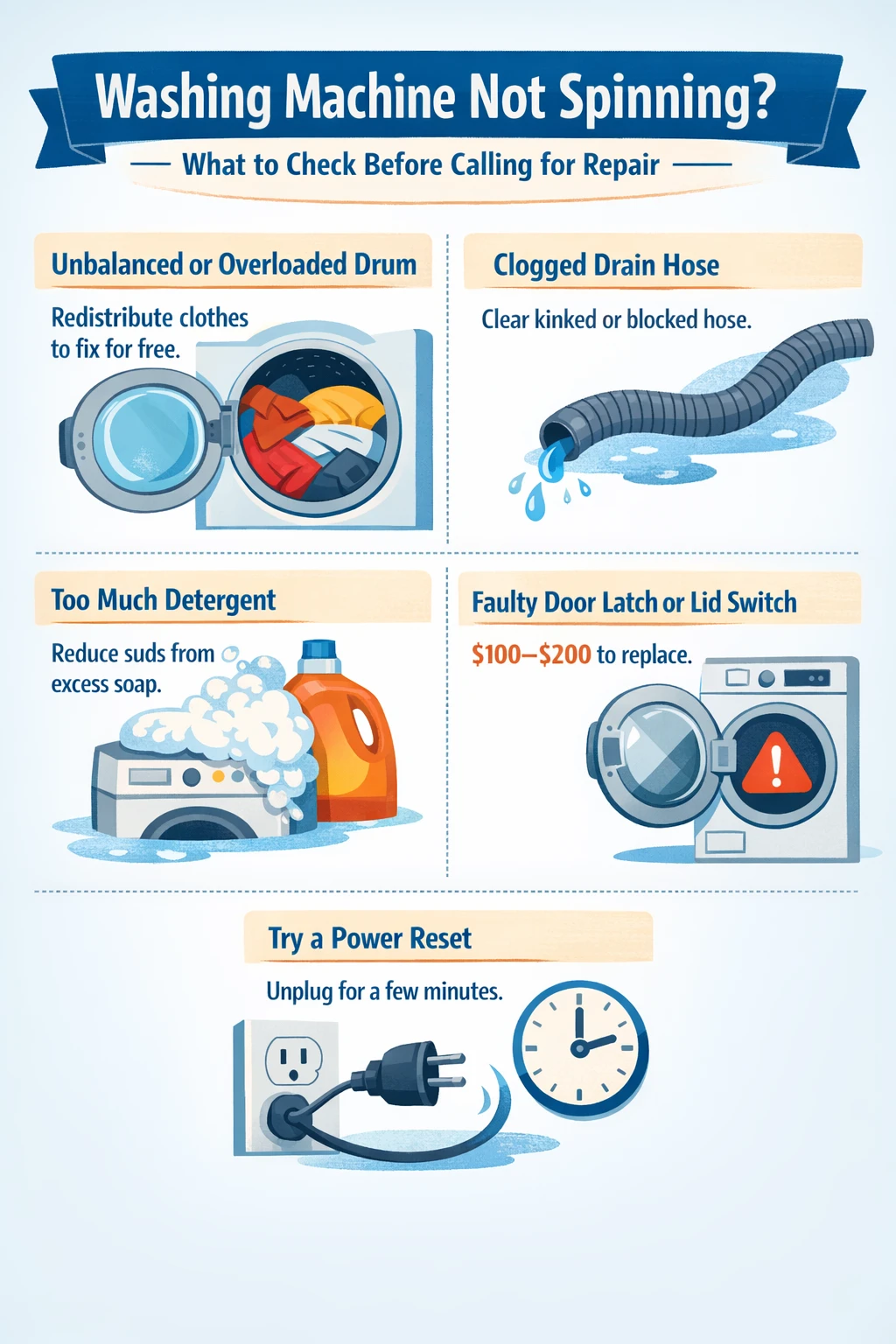
- An unbalanced or overloaded drum is the most common reason a washer stops spinning, and redistributing the load costs nothing to fix.
- A kinked or clogged drain hose can prevent your washer from reaching the spin cycle entirely – check this before assuming the worst.
- Using too much detergent, or the wrong type, can create excess suds that interrupt the spin cycle on high-efficiency machines.
- A faulty door latch or lid switch will stop the spin cycle as a built-in safety measure, and this part typically costs between $100 and $200 to replace professionally.
- If your washer’s motor or drive belt has failed, repair costs generally run between $100 and $400 depending on the part and the machine.
- A simple power reset – unplugging the machine, waiting a few minutes, and plugging it back in – can clear a cycle that got interrupted by a power fluctuation.
Why your washing machine stops spinning
When a washing machine won’t spin, the cause is usually one of a handful of things: an imbalanced load, a drainage problem, a door that isn’t properly latched, or a settings issue. In most cases, the machine isn’t broken – it’s doing exactly what it’s designed to do, which is stop itself before it causes damage or makes a mess. That’s worth knowing, because it means your first job is to figure out what triggered the safety response, not to assume something is broken. Spin issues come in two flavors. Either the washer starts spinning and then stops partway through, or it never spins at all. If it starts and stops, you’re almost certainly looking at a load balance problem, excess suds, or a drainage issue. If it won’t spin at all, the door latch, lid switch, or a power interruption is more likely the culprit. We see both types come up regularly, and the approach is the same either way – start with the simple stuff before you assume it’s a mechanical failure.
Check the load first
 This is where the troubleshooting should always begin, because it’s free, takes 60 seconds, and solves the problem more often than you’d expect. Open the washer and take a look at how the laundry is sitting. If you’ve got one heavy item – a blanket, a bath mat, a pair of jeans – sitting on one side of the drum, the machine’s sensors will detect the imbalance and refuse to spin. It’s a safety feature, not a malfunction. The fix is to redistribute the load so the weight is spread evenly around the drum, or to add another item to balance it out. Overloading is the other side of this coin. Pack the drum too full and the motor can’t build enough speed to complete the spin. A good rule of thumb: fill the drum no more than three-quarters full for regular loads. For heavy items like towels or thick cotton, fill it even less. Washing a single bulky item on its own – like a comforter – almost always causes problems. Toss in a couple of towels to help balance the weight.
What to do if the cycle got stuck mid-spin
If the washer stopped partway through, don’t just restart the cycle and hope for the best. Pause it, open the drum, and rearrange the laundry. Make sure nothing has clumped into a ball on one side. Then close the lid firmly and let it resume. On most machines, you can also select a dedicated drain-and-spin cycle to clear out any standing water first, which gives the machine a cleaner start.
Look at the door latch and lid switch
A washing machine that won’t spin at all – from the very start of the cycle – is often telling you it doesn’t think the door is properly closed. Both front-load and top-load machines have safety mechanisms that prevent spinning if the door or lid latch isn’t fully engaged. On a front-loader, close the door firmly and listen for a click. Some machines display a lock symbol on the control panel to confirm the door is latched. If that symbol isn’t showing, the door hasn’t closed properly, or the latch mechanism itself may be faulty. Sometimes there’s a piece of clothing caught in the seal – pull the door open, check around the gasket, and try again. Top-load machines use a lid switch rather than a latch. When you close the lid, you should hear a faint clicking sound as the switch engages. No click typically means the switch isn’t working. A broken lid switch is one of the more common repairs we see in older top-loaders, particularly in homes around the Museum District and Northside where machines have been running for 10 or 15 years. It’s not an expensive fix, but it does require a professional to replace properly.
Inspect the drain hose
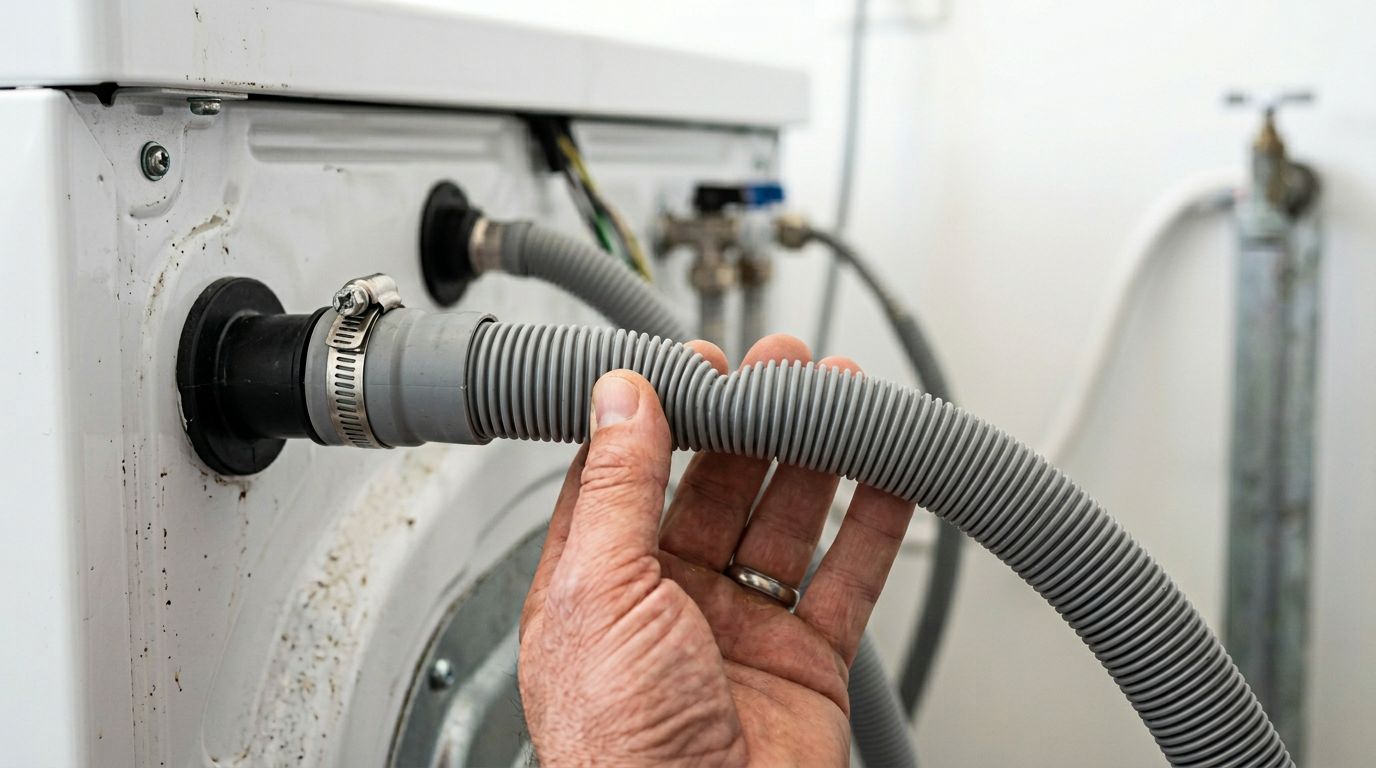 Here’s something a lot of people don’t realize: your washer will not spin if it hasn’t drained first. The machine’s sensors check for standing water before starting the spin cycle, and if the water can’t get out, the spin never starts. So if you’re seeing standing water in the drum at the end of a cycle, drainage is almost certainly your problem. The drain hose runs from the back of the washer to your home’s drain pipe or laundry sink. Pull the machine out from the wall and take a look. You’re checking for two things: kinks and clogs. A hose that’s been bent sharply – maybe the machine got pushed back against the wall – can restrict flow enough to stop drainage entirely. Straighten it out and see if that’s the issue. If the hose looks fine, the clog may be further in. On front-load washers, there’s usually a small filter at the bottom front of the machine (behind a small panel) that catches lint, coins, and other debris. According to manufacturer guidelines, this filter should be cleaned regularly – it’s one of those maintenance tasks most people skip until something goes wrong. For top-loaders, the drain hoses are typically harder to access, and clearing a clog inside the pump itself is usually a job for a professional. The drain hose installation matters too. Manufacturer guidelines specify that the hose should only be inserted about 4.5 inches into the standpipe, and the standpipe itself needs to be between 39 and 96 inches high. If the hose goes in too deep, water can siphon back into the drum instead of draining out. It’s a surprisingly common installation mistake, especially in older homes where someone has moved the machine and reconnected the hose themselves.
Check your detergent
This one surprises people, but too much detergent – or the wrong type – can genuinely stop your washer from spinning. High-efficiency machines are designed to use very little water, which means excess suds have nowhere to go. When the machine detects too much foam, it will pause or extend the cycle to try to rinse it away, and it may skip or slow the spin cycle in the process. If you’re using a standard detergent in an HE machine, switch to an HE-rated product. If you’re already using HE detergent but the suds problem persists, you’re likely using too much. Check the packaging for the recommended amount, and keep in mind that in areas with softer water – which you’ll find in parts of Richmond – you often need significantly less detergent than the label suggests. The fix here is straightforward. Run a rinse-and-spin cycle to clear out the suds, then wash again with the correct amount of detergent. For more on washing machine maintenance, the U.S. Department of Energy has helpful guidance on efficient laundry practices that can extend your machine’s life.
Level the machine and check for a power reset
A washer that rocks or vibrates excessively during the spin cycle isn’t just annoying – it will eventually trigger the machine’s automatic shutoff to prevent damage. If your machine shimmies across the floor, the feet need adjusting. With the machine empty and unplugged, try to rock it gently. If it moves, the leveling legs aren’t making even contact with the floor. Most machines have adjustable feet you can turn by hand or with a wrench – turn counterclockwise to lower, clockwise to raise. Get all four feet making firm contact with the floor, and if your laundry room floor is uneven (common in older Richmond homes with original hardwood or tile), rubber anti-vibration pads can make a real difference. You can check your work with a basic spirit level placed on top of the machine. Power interruptions are worth mentioning too. If the power flickered during a cycle, the washer may have stopped mid-spin and can’t figure out where it left off. The simplest fix is to unplug the machine, wait two or three minutes, and plug it back in. Then select a drain-and-spin cycle to clear any remaining water. This clears the machine’s memory and lets you start fresh. It sounds almost too simple, but it works more often than you’d think.
When it’s time to call a professional
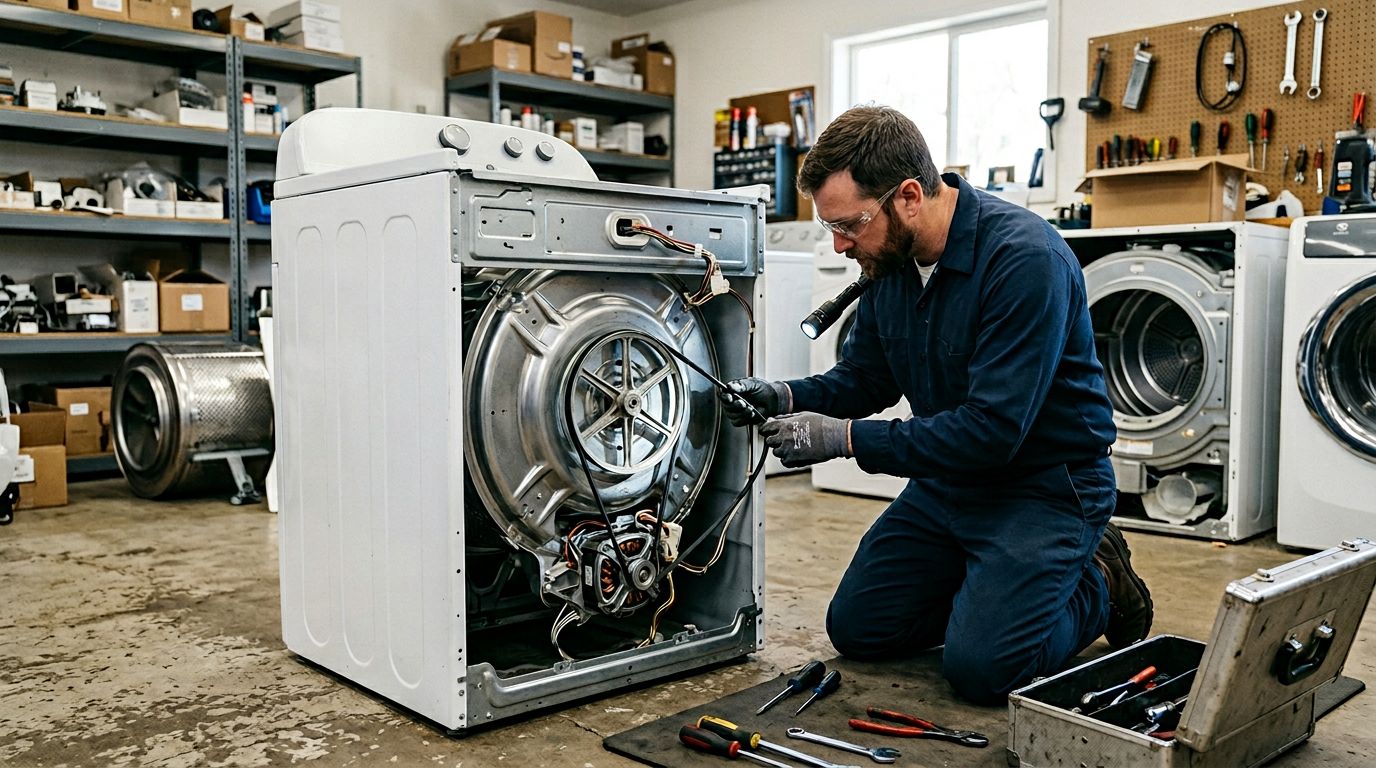 If you’ve worked through everything above and the drum still won’t spin, you’re likely dealing with a mechanical issue that needs a trained eye. The most common culprits at this stage are a worn or broken drive belt, a failing motor, or a damaged drum bearing. A broken drive belt is the classic middle-ground repair. You might hear squealing, grinding, or clicking sounds during the cycle, or the drum may move freely by hand but won’t spin under power. Replacing a belt typically runs between $100 and $200 depending on the machine. A burned-out motor is more serious – the machine may make no sound at all during the spin cycle, or you might notice a faint burning smell. Motor replacement generally costs between $200 and $400. Drum bearing failure is most common in front-loaders and tends to announce itself with a loud rumbling or grinding noise during the spin. It’s a complex repair that requires partial disassembly of the machine, so professional service is the right call. In our experience, this tends to come up more in machines that are eight or more years old – something we see fairly often in the Scott’s Addition and Carytown areas where many residents are holding onto appliances longer. Before calling anyone, check whether your machine is displaying an error code. LG, Samsung, and most other major brands use these codes to indicate specific problems. A quick search of your model number plus the error code will often tell you exactly what the machine is diagnosing. That information is genuinely useful to have when you do speak to a technician, and it can speed up the diagnosis. LG’s support documentation, for example, walks through common error codes and what they mean.
Frequently asked questions
These are the questions we hear most often when someone calls about a washing machine not spinning. If your situation matches one of these, the answer may be simpler than you’re expecting.
Why does my washer fill with water but then not spin?
If the machine fills normally but won’t move into the spin cycle, the most likely cause is a drainage problem. Your washer checks to confirm the water has drained before it starts spinning, so if there’s a clogged drain hose, a blocked pump filter, or an installation issue with the drain hose, the machine will sit full and wait. Check the hose for kinks and, on front-loaders, clean the pump filter. On top-load machines, drainage problems are usually best handled by a professional since the hoses are harder to access.
My clothes come out soaking wet even though the cycle completed. What’s going on?
This usually means the washer is spinning, but at a much lower speed than it should be. Check the cycle you’ve selected – delicate, hand wash, and gentle cycles are designed to spin slowly to protect fabrics, which leaves more water in the load. That’s normal. If you’re on a regular or heavy-duty cycle and clothes are still coming out very wet, an imbalanced load or excess suds may be slowing the spin speed. Also check your spin speed setting if your machine has a separate control for it.
Can I reset my washing machine to fix a spinning problem?
Yes, and it’s worth trying before anything else. Unplug the machine from the wall, wait two to three minutes, then plug it back in. This clears the machine’s cycle memory and can resolve issues caused by a power interruption or a sensor that got confused mid-cycle. From there, select a drain-and-spin cycle to remove any standing water. Different brands have slightly different reset procedures, so check your owner’s manual for model-specific steps. GE’s support documentation, for instance, walks through a motor reset process for Hydrowave models that doesn’t require any tools. You can find general guidance on the GE Appliances support page.
How do I know if the problem is the motor or the drive belt?
They produce different symptoms. A bad drive belt usually makes noise – squealing, grinding, or a rhythmic thumping – and the drum may feel loose when you turn it by hand. A burned-out motor is typically quieter: the machine may be completely silent during the spin cycle, or you might notice a faint burning smell near the machine. Both require professional repair, but the distinction is helpful when you’re describing the problem to a technician.
Is it worth repairing a washing machine that won’t spin, or should I just replace it?
It depends on the age of the machine and the cost of the repair. As a general rule, if the repair costs more than half the price of a comparable new machine, replacement starts to make more economic sense. A broken lid switch or a clogged drain pump at $50 to $150? Almost always worth fixing. A failed motor on a 12-year-old machine that would cost $350 to repair? That’s worth getting a second opinion on before committing. A technician who can explain the diagnosis clearly before asking you to approve the work is a good sign you’re dealing with someone trustworthy.
Wrapping up
Most of the time, a washing machine not spinning comes down to something fixable without a service call – an imbalanced load, a kinked drain hose, a door that didn’t latch fully, or a simple power reset. Start with the easy checks, work through them methodically, and you’ll often have the machine running again before the afternoon is out. If you’ve gone through everything here and the drum still won’t move, the issue is likely mechanical, and that’s when it’s time to bring in a professional. At Top Appliance Repair Richmond, we handle washer repair, dryer repair, and appliance diagnostics across Richmond and the surrounding area. If you’re not sure what you’re dealing with, or if you’d simply rather not spend your Saturday pulling the machine away from the wall, give us a call and we’ll help you figure out the best path forward.