Your oven was preheated twenty minutes ago, and it still feels lukewarm inside nobody wants that kind of surprise when dinner is on the line. This guide walks you through the most common reasons an oven stops heating properly, what you can safely check yourself, and when it makes more sense to call in a professional.
A malfunctioning oven has a way of making itself known at the worst possible time right before a holiday meal or on a busy weeknight. The good news is that most heating problems come down to a handful of familiar culprits, and some of them are genuinely easy to diagnose. At Top Appliance Repair Richmond, we field calls about ovens not reaching temperature on a regular basis, and the pattern is pretty consistent: a few simple checks rule out the easy stuff, and from there, you can decide whether this is a DIY situation or one that needs a technician.
Richmond’s housing stock includes a solid mix of older homes with aging appliances and newer builds where installation quirks sometimes show up early. Either way, the causes of an oven not heating properly tend to be the same across the board. Let’s get into it.
Key takeaways
- The two most common causes of an oven not heating are a failed heating element (electric ovens) or a faulty igniter (gas ovens) both are identifiable without special tools.
- A damaged or mispositioned temperature sensor can cause your oven to cut heat too early, leaving food undercooked even when the display shows the right temperature.
- Most ovens take 12 to 15 minutes to preheat properly; significantly longer times suggest an airflow issue, a weak element, or a calibration problem.
- An oven door that does not seal fully allows heat to escape and will make the appliance struggle to hold any consistent temperature.
- Oven calibration can often be adjusted at home, sometimes by as much as 35 degrees Fahrenheit in either direction, using the built-in electronic controls.
- If your gas oven is not heating and you smell gas, stop troubleshooting immediately and call a professional or your gas utility provider.
Why your oven is not heating properly
The short answer: either heat is not being generated, or it is not being retained. Those two failure points cover the vast majority of cases. An electric oven that stopped heating almost always has a broken baking element or a faulty temperature sensor. A gas oven that will not heat is usually dealing with an igniter problem or a disrupted gas supply. Everything else calibration drift, door seal issues, a tripped breaker falls into a category of “the oven is technically working, but not correctly.”
Start with the obvious before assuming the worst. Check that the oven is plugged in and that the circuit breaker has not tripped. It sounds almost too simple, but a partial trip on a double-pole breaker can cut power to the oven while leaving other nearby outlets working fine. Flip the breaker fully off and then back on. If the oven comes back to life, you are done. If the breaker trips again immediately, that is an electrical issue that needs a licensed electrician, not an appliance technician.
We see this fairly often in older Bon Air homes where the electrical panels have not been updated to match modern appliance loads. A dedicated 240-volt circuit is required for most electric ranges, and a panel that is running close to capacity can cause repeated breaker trips. Worth knowing before you assume the oven itself is broken.
Electric oven heating problems: what to look for
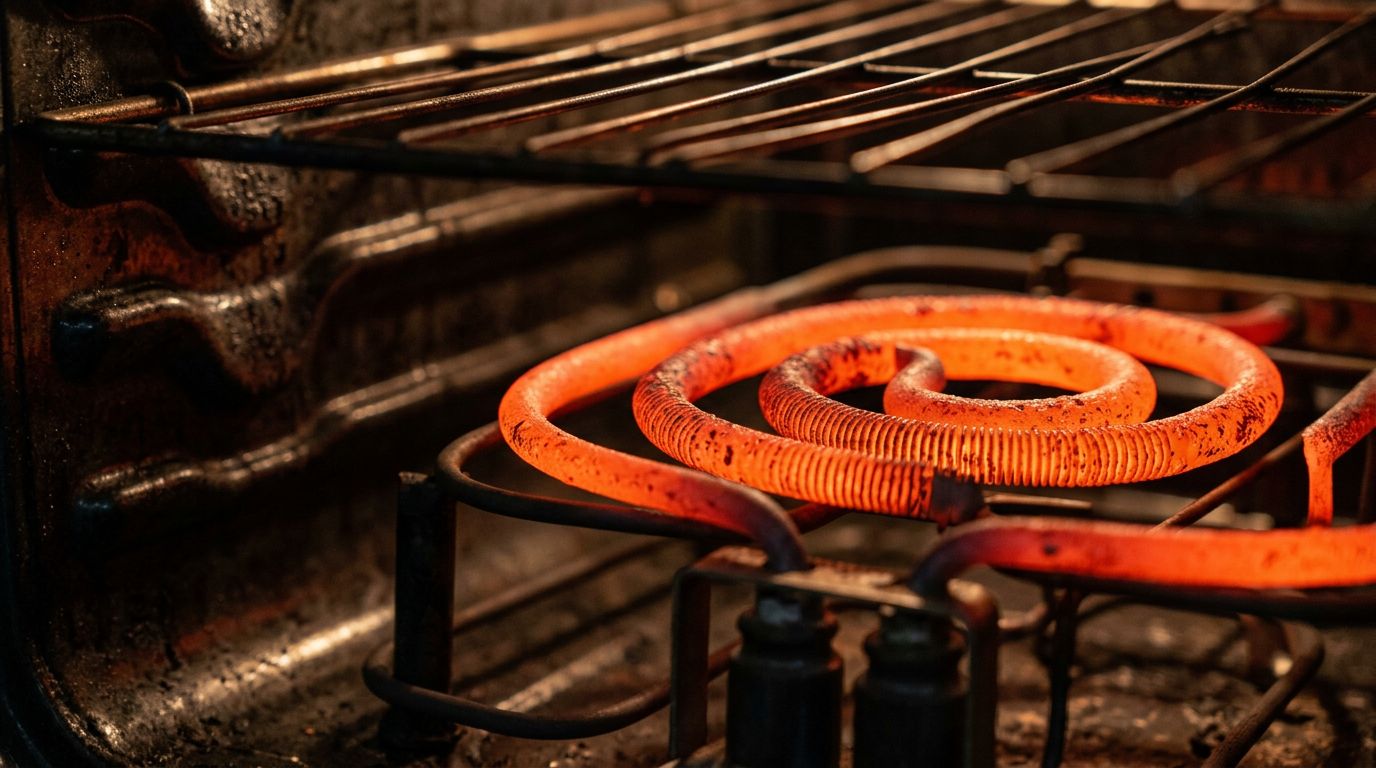
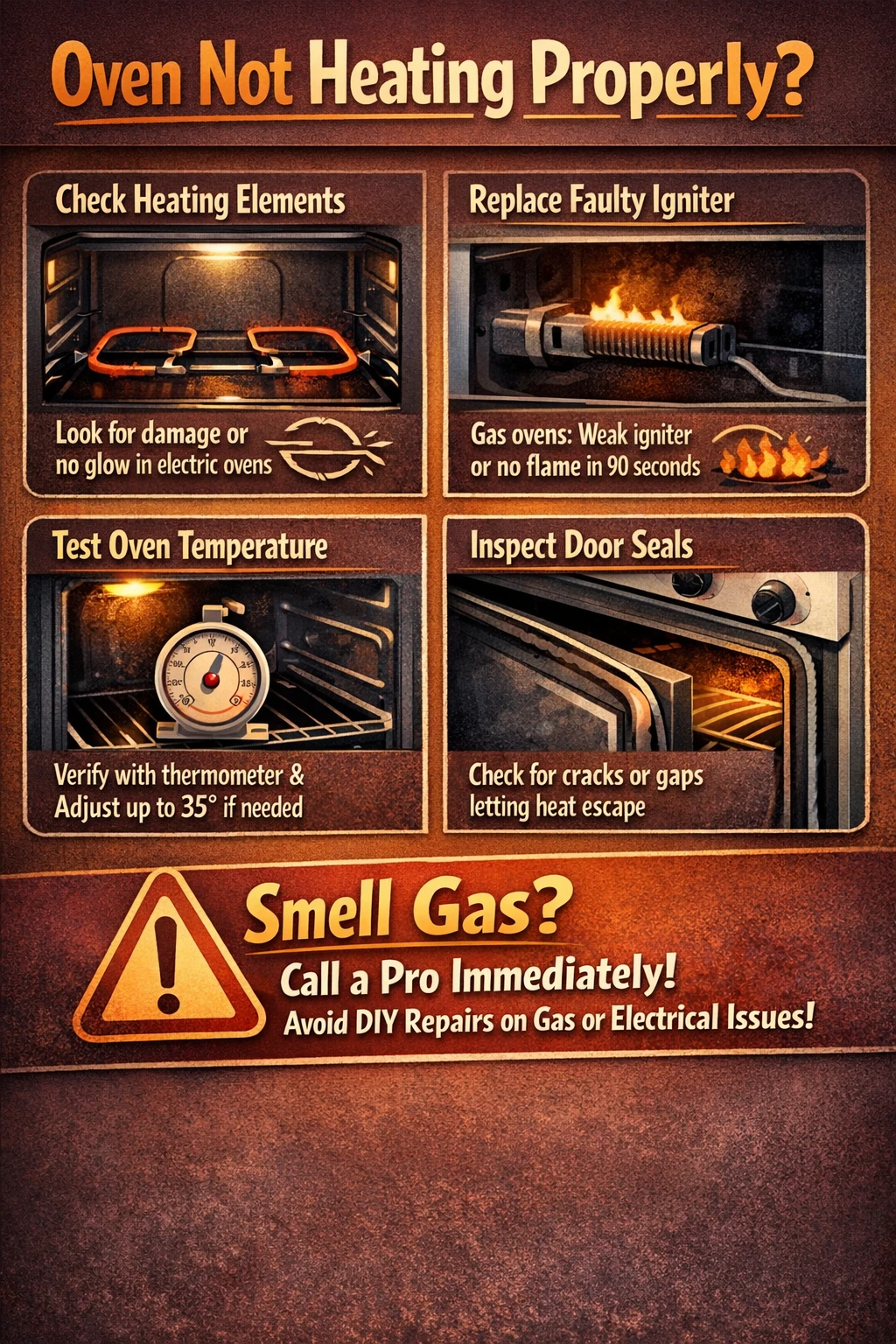
Electric ovens rely on two heating elements: the bake element at the bottom of the oven cavity and the broil element at the top. Both should glow a steady, bright red-orange when they are working. If you turn on your oven and one element stays dark, that is a strong sign it has burned out.
Look closely at the element itself. Cracks, blisters, or visible burn marks are all signs that a replacement is needed. A healthy element looks smooth and glows evenly. A dead one may look fine to the eye but simply produce no heat in that case, a technician can test it with a multimeter to confirm. Replacing a baking element is one of the more straightforward appliance repairs out there, but because the oven needs to be fully disconnected from power first and the wiring connections handled carefully, it is worth having a professional do the swap if you are not confident working around high-voltage wiring.
If both elements look fine but the oven still is not reaching temperature, shift your attention to the temperature sensor. This is a thin probe, usually mounted at the back of the oven interior. Its job is to read the actual temperature inside the cavity and tell the controls when to increase or cut the heat. If the sensor is touching the oven wall, has been bumped out of its mounting, or has simply failed, it will send incorrect readings to the control board. The oven may cut power to the elements long before the target temperature is reached. Sensor position matters: it should sit at roughly a 90-degree angle to the back wall, not resting against any surface. Sometimes simply repositioning it resolves the issue. If not, the sensor itself can usually be replaced without much difficulty.
Calibration drift in electric ovens
Ovens can drift out of calibration over time. This is not a failure, exactly it is just wear. An oven that used to run true at 350 degrees might now run 20 or 25 degrees cool, which shows up as food that takes longer to cook or baked goods that never quite set properly. An inexpensive oven thermometer is the fastest way to check this. Set the oven to 350 degrees, let it fully preheat, and compare what the thermometer reads against what the display shows.
Many electric ovens with electronic controls allow you to adjust the calibration yourself. On some models, pressing the BAKE and BROIL buttons simultaneously for about two seconds brings up a calibration mode, and you can shift the temperature setting up or down by up to 35 degrees Fahrenheit. Check your specific model’s documentation for the exact process. For analog ovens with a dial, there is usually a small calibration screw underneath the knob that can be turned to make adjustments. This is one of those fixes that looks intimidating but is genuinely manageable once you know it exists. The U.S. Department of Energy’s appliance guidance is a helpful starting point for understanding how oven efficiency and proper calibration connect.
Gas oven heating issues: igniter and beyond
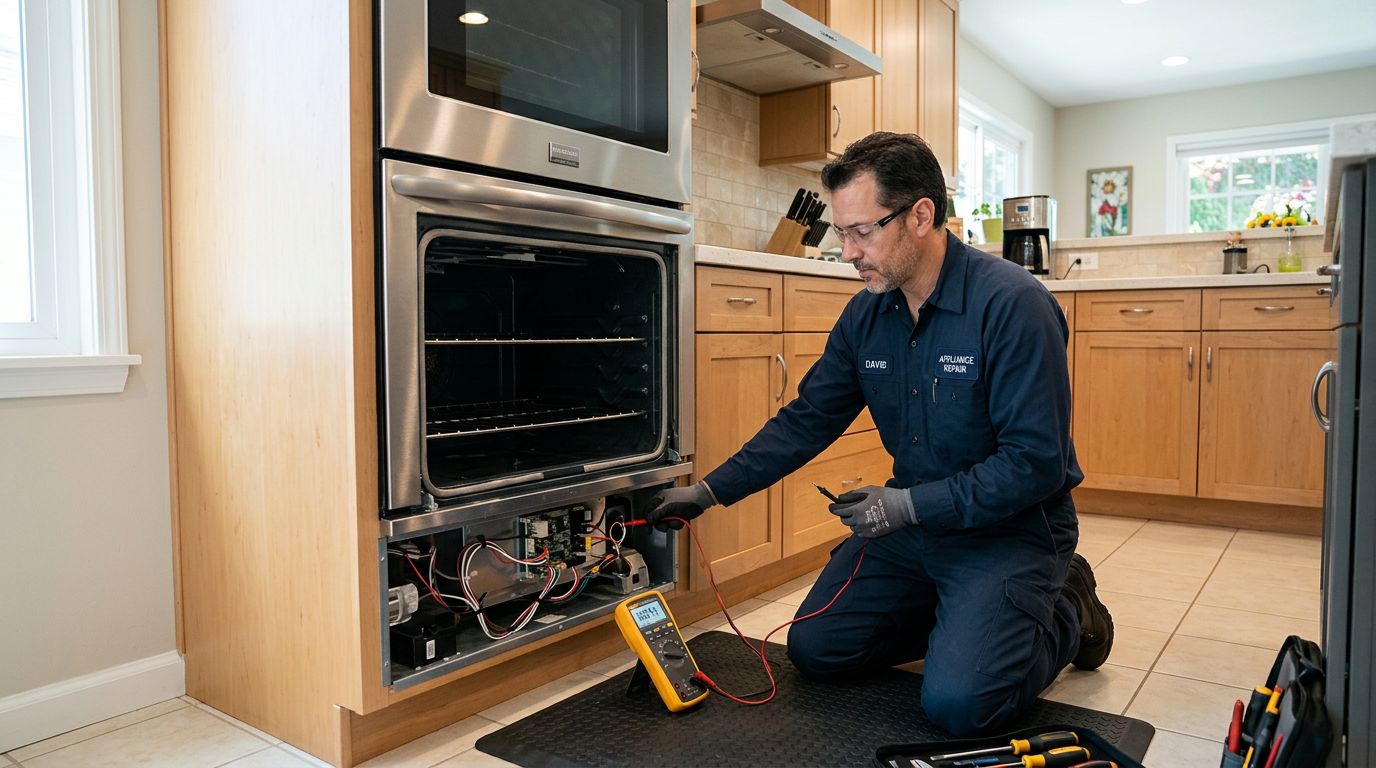
A gas oven that will not heat is a slightly different puzzle. The process starts with the igniter, which has to get hot enough to open the gas valve before the burner can light. If the igniter is weak or failing, it may glow but not get hot enough to trigger the valve or it may not glow at all.
You can often watch this happen in real time. Look through the oven window (or carefully open the door a few inches) after you turn on the oven. You should see the igniter glow bright orange within about 30 to 90 seconds, followed by the gas igniting with a soft whomp. If the igniter glows but the gas never lights, or if it takes more than two minutes to ignite, the igniter is probably too weak and needs replacement. If it does not glow at all, the igniter has likely failed entirely. Either way, this is not a safe DIY repair for most homeowners. Turn the oven off, let it air out, and call a technician.
A dirty igniter is a separate issue. Grease and food debris can build up on the igniter surface and interfere with its performance. Your appliance care guide should include instructions for gentle cleaning. In our experience, a cleaning resolves the problem in some cases, but if the igniter has been struggling for a while, replacement is usually the more reliable path.
Gas supply and valve problems
If the igniter looks fine but the oven still will not heat, check the gas supply. There is a shutoff valve on the gas line behind or below the range confirm it is in the fully open position. If your range was recently serviced or moved, there is a real chance the valve was left closed. Also check whether your stovetop burners are working normally. If the burners light fine but the oven does not, the issue is almost certainly internal to the oven. If neither the burners nor the oven will ignite, the problem is likely upstream with the gas supply itself.
Do not attempt to inspect or repair gas line connections yourself. That work requires a licensed technician and, in some jurisdictions, a permitted inspection. This is one of those areas where the risk genuinely outweighs the savings of a DIY approach. For detailed safety information on gas appliances, the U.S. Consumer Product Safety Commission maintains useful guidance on gas appliance hazards.
The oven door: a surprisingly common culprit
A door that does not seal properly is one of those problems that looks minor but has a big effect on heating performance. Heat escaping through a gap around the door is heat the oven has to constantly replace, which means longer preheat times, inconsistent temperatures, and higher energy use. It is also one of the easier things to check.
Open the oven door and inspect the gasket the rubber or silicone seal that runs around the door frame. Look for cracks, tears, flattened sections, or spots where it has come loose from its channel. A healthy gasket should spring back when you press it. A worn one stays compressed or feels stiff and brittle. Gaskets can often be ordered and replaced without professional help, and they are generally not expensive. While you are at it, check that the oven racks are seated correctly and that nothing inside the cavity is blocking the door from closing fully.
Some self-cleaning ovens have a separate door locking mechanism. If that lock is partially engaged, the door will not close properly. Make sure it is fully in the unlocked position when you are trying to bake normally.
When to stop troubleshooting and call a technician
Some repairs fall clearly into the “call a professional” category. Replacing a heating element or temperature sensor is manageable for a reasonably handy homeowner who is comfortable disconnecting power and working carefully. Adjusting calibration is even simpler. But anything involving electrical wiring, control boards, or gas connections is a different matter.
If you smell gas at any point, stop. Turn off the oven, open windows, and get out of the house before calling your gas utility or a repair service. Do not flip any switches or use your phone inside the house until you are clear of the area. That is not a troubleshooting step that is a safety protocol.
For everything else, the decision usually comes down to cost and appliance age. If your oven is more than 10 to 15 years old and the repair involves a control board or multiple components, it may be worth running the numbers on a replacement. A control board repair can run several hundred dollars, and on an older appliance, that starts to approach the cost of a new entry-level range. On a newer oven, the same repair makes clear financial sense. Honest advice: if a technician quotes you a repair that costs more than half the price of a comparable new appliance and the oven has some age on it, ask whether a replacement might serve you better in the long run.
We get a lot of calls from homeowners in The Fan and Church Hill dealing with exactly this question. Older homes, older appliances, and the repair-or-replace math does not always land the same way. There is no universal right answer, but a straightforward diagnosis at least gives you the information to decide.
Frequently asked questions
A few questions come up consistently when homeowners start looking into oven heating problems. Here are the ones we hear most often, along with direct answers.
Why does my oven take so long to preheat?
Most ovens take between 12 and 15 minutes to reach a typical baking temperature of around 350 degrees Fahrenheit. If yours is taking 30 minutes or more, something is off. Common causes include a partially failed baking element that is still working but not producing full heat, an out-of-calibration temperature sensor that is cutting the heat cycle short, or restricted airflow from foil lining the oven floor or racks. Remove any foil, make sure the oven racks are not blocking the vents, and use an oven thermometer to see how the actual temperature tracks against the set temperature over time.
Can I replace the heating element myself?
In many cases, yes but with some important caveats. The oven must be fully unplugged or the breaker must be switched off before you touch anything inside. Most baking elements are held in place by two screws and connected by two wires, and the process is straightforward if you take your time and photograph the connections before you disconnect them. That said, if your oven is under warranty, a DIY repair may void it. And if you are not entirely comfortable working around electrical connections, there is no shame in handing it off to a professional. A small repair done incorrectly can become a larger and more expensive one.
Why is my oven temperature not accurate even after it preheats?
Calibration drift is the most likely answer. Ovens naturally shift over time, and an oven that runs 25 degrees cool will produce consistently undercooked food even if it feels like it is working normally. An oven thermometer confirms this quickly and inexpensively. If the calibration is off, many ovens allow you to correct it through the control panel settings. Check your owner’s manual for the specific process. If the thermometer shows the oven temperature swinging wildly rather than sitting steadily near the target, that points more toward a sensor or control board issue, which is worth having a technician look at.
My gas oven lights but goes out after a minute or two – what is happening?
This is usually a sign that the igniter is drawing current but not generating enough heat to keep the gas valve open. The valve is designed to require a minimum heat threshold before it stays open, as a safety feature if the igniter is weak, the valve opens briefly and then closes again when the threshold is not maintained. The result is a burner that lights and then dies. Igniter replacement is the typical fix here. This is a repair where we strongly recommend using a technician, both for safety and because getting the right igniter for your specific model matters. For GE appliance owners, the GE Appliances support page is a useful resource for locating the correct replacement parts by model number.
Wrapping up
Most oven heating problems come down to a short list of familiar parts: the heating element or igniter, the temperature sensor, the door seal, or calibration drift. Start with the easy checks power supply, breaker, door seal before assuming you are dealing with something more serious. When you do need to get into components, know where the line is between a manageable DIY fix and a job that calls for professional help, particularly anything involving gas lines or high-voltage wiring. If your oven is newer and a single part has failed, a repair almost always makes sense. If it is older and multiple things are going wrong, replacement might be the more practical choice.
At Top Appliance Repair Richmond, we handle oven repair along with a full range of appliance work across Richmond and the surrounding area from dryer repair and washer repair to fridge, dishwasher, and stove issues. If you are not sure what is wrong or you would rather not dig into it yourself, give us a call. We can help you figure out what is actually going on and what the repair is realistically going to involve before you commit to anything.