Your refrigerator stopped cooling, and now you’re standing in the kitchen wondering whether dinner is salvageable and whether you’re about to spend a thousand dollars you didn’t plan on spending. This guide walks you through the most common reasons a fridge stops keeping food cold and shows you exactly what to check before you call anyone. Nobody wants to come home to warm milk and soft ice cream. A refrigerator that’s not cooling is one of those problems that feels urgent the moment you notice it and rightly so, because food safety is on the line within hours. At Top Appliance Repair Richmond, we get these calls regularly, and the honest truth is that a good portion of them turn out to be something the homeowner could have caught and fixed themselves. Richmond’s older housing stock means a lot of homes here are running refrigerators that are ten, fifteen, even twenty years old, and those machines have earned a few quirks. That said, not every warm fridge means a dead compressor or a refrigerant leak. Before you panic, let’s work through the list. Most of the time, the fix is simpler than you’d expect.
Key takeaways
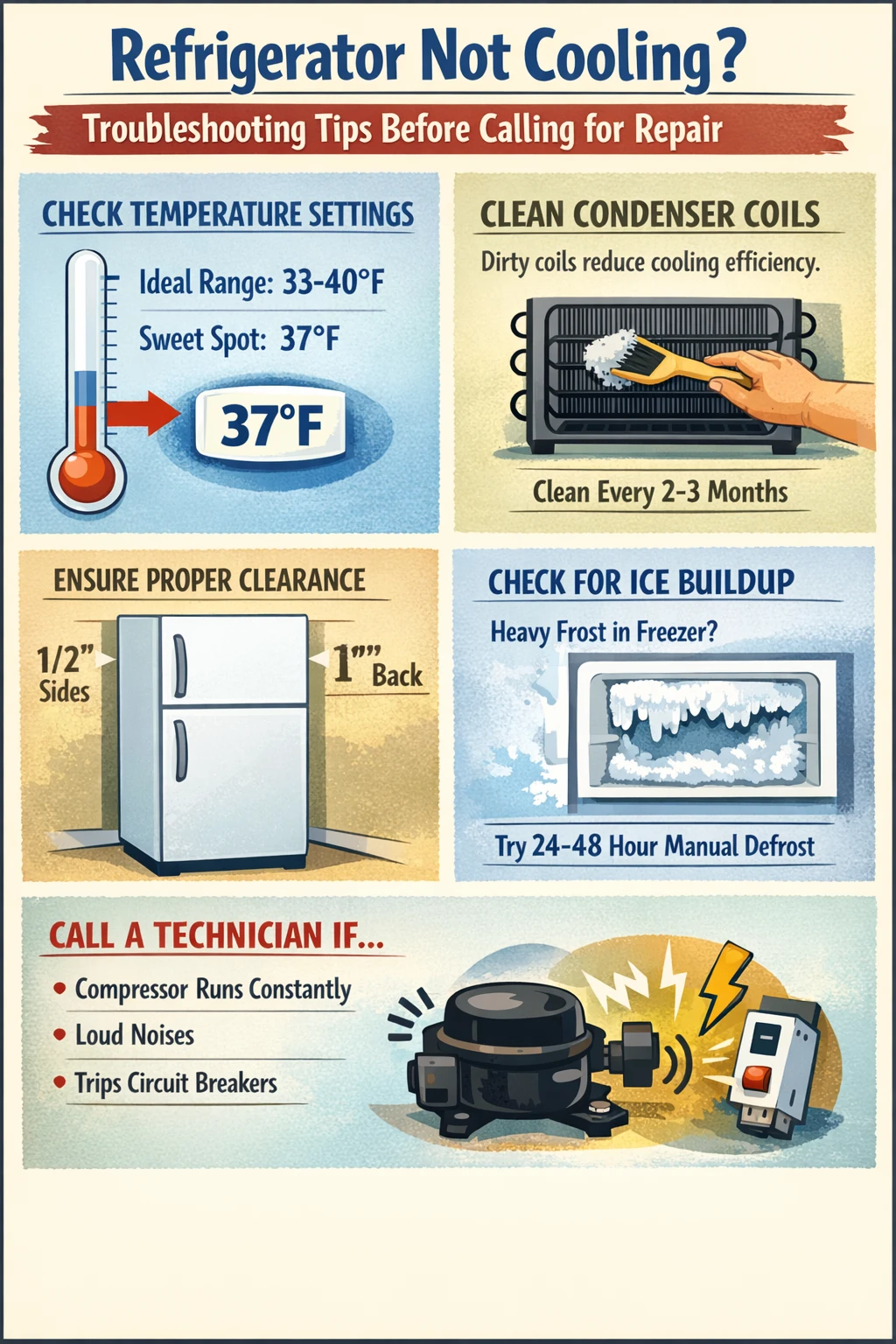
- The ideal refrigerator temperature is between 33°F and 40°F, with 37°F being the sweet spot recommended by most manufacturers.
- A new refrigerator needs at least 24 hours for its internal temperature to fully stabilize after installation or after being unplugged.
- Dirty condenser coils are one of the most overlooked causes of poor cooling cleaning them every two to three months can prevent the problem entirely in dusty or pet-friendly homes.
- Ice buildup on the back wall of the freezer is a red flag that the self-defrost system may have failed, and letting the fridge thaw manually for 24 to 48 hours is a cheap diagnostic test.
- Refrigerators need at least a half inch of clearance on the sides and one inch at the back to release heat properly.
- If the compressor is running constantly, making unusually loud noises, or tripping your circuit breaker, those are signs to stop troubleshooting yourself and call a technician.
Why your refrigerator is not cooling: start here
When a fridge stops cooling, the most likely cause is something simple a blocked vent, a dirty coil, a door gasket that’s no longer sealing properly, or a temperature setting that got bumped accidentally. These account for the majority of “fridge not keeping food cold” calls we see. The more serious culprits, like a failed compressor or a refrigerant leak, are real possibilities, but they’re usually accompanied by other signs that make them easier to identify. First things first: open the fridge and check whether the interior light is on. If the light is out and the fridge is silent, you may just be dealing with a power issue a tripped breaker, a GFI outlet that needs resetting, or a plug that worked loose. It sounds obvious, but it gets missed more often than you’d think. One homeowner on a repair forum traced her problem to the outlet itself, not the appliance at all. If the light is on and the fridge is humming but not cooling, you’re dealing with something internal. That’s where the checklist below becomes useful.
Check these things before anything else
 The fastest wins are the ones you can fix in ten minutes without tools. Go through these in order.
Temperature settings
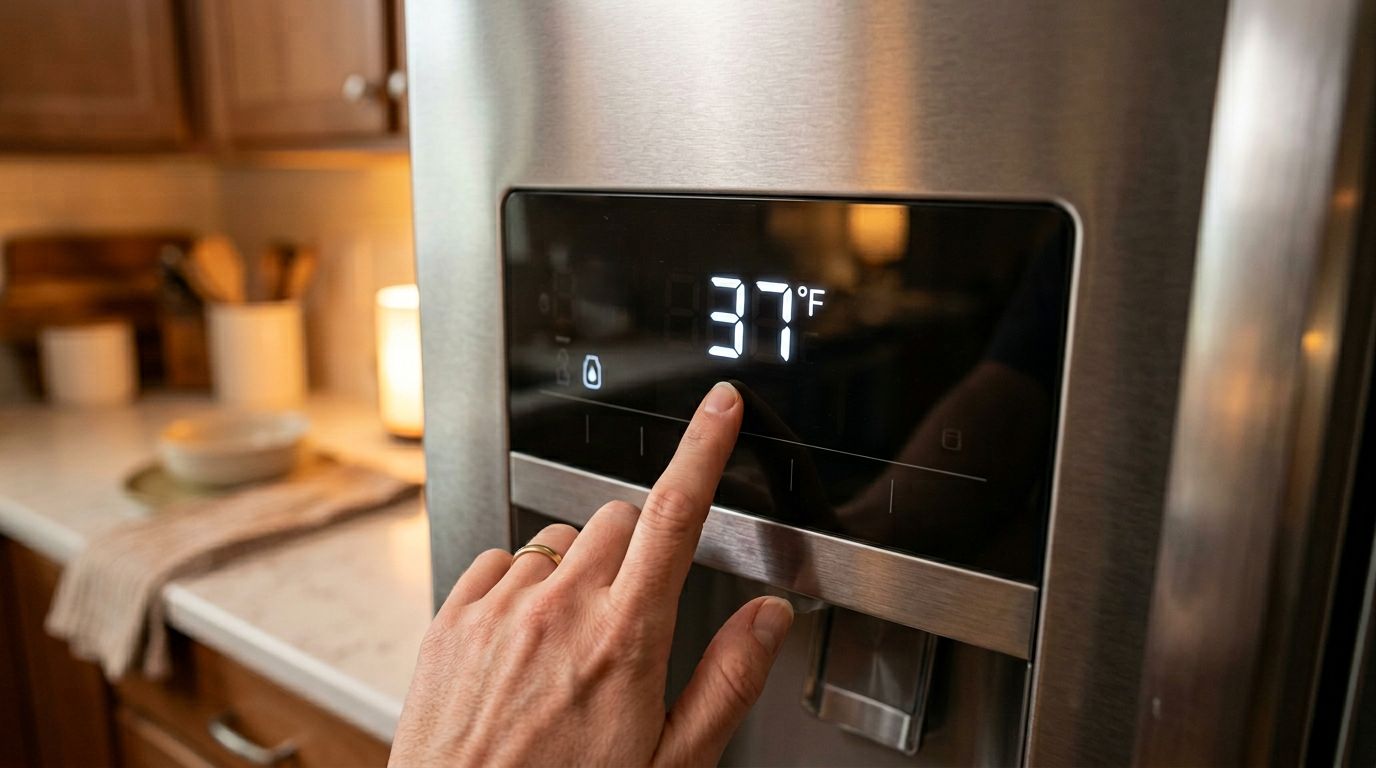
Check your thermostat first. The factory-recommended settings on most brands are 37°F for the refrigerator compartment and 0°F for the freezer. It’s surprisingly easy for the controls to get nudged a grocery bag brushing past the panel, a kid curious about the buttons. If your fridge has digital controls, check them against the manual. If the display shows something outside the normal range, reset it and give the appliance a full 24 hours to stabilize before drawing any conclusions.
Blocked air vents
Refrigerators cool by circulating air through internal vents. Pack your fridge too tightly, or shove a container right up against a vent, and that circulation stops. The result is warm spots or a fridge that runs constantly but never gets cold enough. Pull everything out and take a look. You want clear space around the vents, especially the ones at the back wall. While you’re at it, check whether the freezer vent has frost or ice built up over it that’s a separate issue we’ll cover in a moment.
Door gaskets
The rubber seal around your refrigerator door is doing more work than it gets credit for. A worn or dirty gasket lets cold air leak out continuously, and the compressor has to work harder and harder to compensate. Clean the gasket with warm soapy water and check for tears, compression, or spots where it’s pulling away from the door. There’s an easy test for this: close the door on a dollar bill and pull it out. You should feel noticeable resistance. If the bill slides right out, the seal isn’t doing its job. Gaskets on older machines and we see a lot of these in the Northside and Museum District neighborhoods of Richmond can harden and crack over time and may need replacing.
Clearance and leveling
Your fridge releases heat through the back and sides as part of the cooling cycle. If it’s pushed flush against a wall or jammed into a tight cabinet space, that heat has nowhere to go and the compressor overheats. Check that you have at least a half inch on each side and a full inch at the back. Leveling matters too. An unlevel fridge can prevent the doors from sealing correctly and cause temperature swings. Use a level on top of the appliance, checking both side-to-side and front-to-back. If it’s off, adjust the feet until it sits flat.
The condenser coils: the most overlooked maintenance item
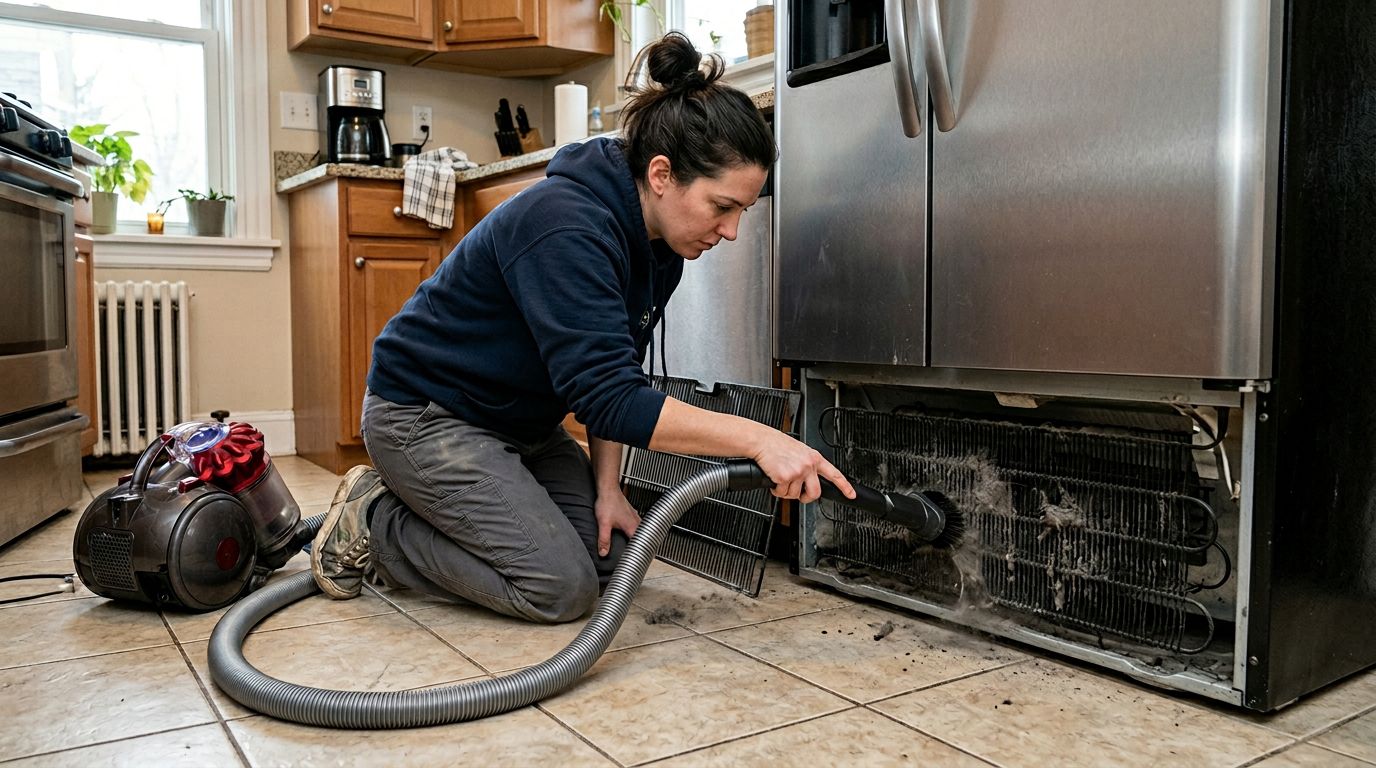 Honestly, this is one of those fixes that looks scarier than it is. Condenser coils are what allow your refrigerator to shed heat, and when they’re coated in dust, pet hair, and grease, they can’t do that job. The compressor ends up straining against itself, and cooling suffers. Most refrigerators have their condenser coils either at the bottom behind a kick panel or at the back of the unit. Unplug the fridge before you touch anything. Remove the kick panel or pull the unit out from the wall, and use a vacuum with a brush attachment or a dedicated coil brush to clear the debris. It’s genuinely one of the best things you can do for a fridge’s long-term performance. How often? In a clean home with no pets, once a year is probably fine. If you have dogs or cats, or if your kitchen gets greasy, do it every two to three months. The U.S. Department of Energy notes that keeping coils clean is one of the simplest ways to maintain appliance efficiency.
Ice buildup and the self-defrost system
This one surprises people. A refrigerator that’s not cooling can sometimes be caused by too much ice specifically, ice built up on the evaporator coils inside the freezer wall. Here’s how it works. Modern refrigerators run an automatic defrost cycle roughly four times every 24 hours. During each cycle, a small heating element melts any frost that’s accumulated on the evaporator coils. If the defrost timer, the defrost thermostat, or the heating element fails, that frost keeps building. Eventually, the coils are buried in ice and the circulating fan can’t pull air across them anymore. The fridge gets warm even though the compressor is still running. The tell-tale sign is frost or ice on the inside walls of the freezer. If you see that, here’s a free diagnostic test: remove all perishable food, turn the thermostat off, and leave the doors open for 24 to 48 hours. Let everything thaw completely. Then turn it back on. If it cools properly after that, you’ve confirmed the self-defrost system is the problem. If it works for a week and then ices up again same result every time you’re looking at a failed component in that defrost circuit. The three components to suspect are the defrost timer, the defrost thermostat (sometimes called the bi-metal switch), and the defrost heating element. A defrost timer can sometimes be freed up temporarily by manually turning it with a flat screwdriver, though that’s a stopgap. Replacement parts are typically inexpensive, but getting to them requires removing interior panels, and the diagnosis has to be accurate first.
When the problem is more serious
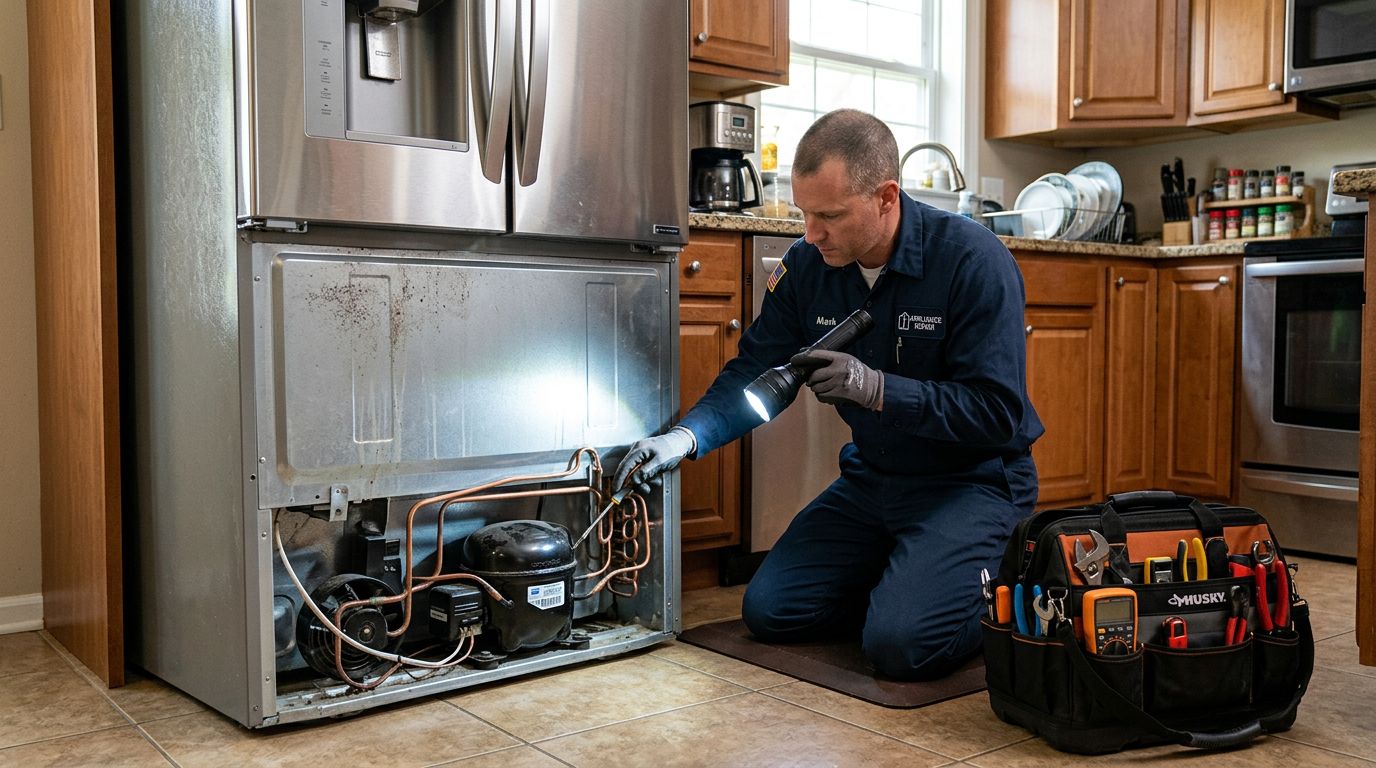 If you’ve worked through everything above and the fridge still isn’t maintaining temperature, the issue is likely in the mechanical or electrical components. These are worth understanding before you call someone, because knowing the terminology helps you evaluate what you’re being told.
The compressor
The compressor is what drives the entire cooling cycle. A normal, healthy compressor makes a gentle hum or whir. Signs of trouble include a compressor that runs without stopping, one that makes unusually loud noises, or a circuit breaker that keeps tripping when the fridge kicks on. Some compressors will start, run for a moment, then click off that click often points to a bad start relay, which is a small, inexpensive part worth checking before assuming the whole compressor is gone. A start relay replacement is a reasonable DIY repair. The compressor itself is not. Compressor replacement requires specialized equipment, welded refrigerant lines, and the kind of tools that aren’t in most homeowners’ garages. Parts alone are typically over $300, and when you factor in labor on an older machine, the math often doesn’t work in the repair’s favor.
Refrigerant leaks
If the compressor is running, the fans are turning, and there’s no ice buildup, but the fridge still can’t hold temperature, a refrigerant leak is possible. A fridge with a slow leak will often cool down initially after a reset, then gradually lose its ability to maintain temperature over several hours a pattern that’s frustratingly easy to mistake for other issues. Checking and recharging refrigerant requires specialized equipment and, in the US, EPA certification to handle refrigerants legally. This is a job for a technician. You can learn more about refrigerant types and handling through the EPA’s Section 608 program page.
Evaporator fan, condenser fan, and the circuit board
Open the freezer door and listen. You should hear a fan running. If you don’t, the evaporator fan may have failed and without it, cold air doesn’t circulate into the refrigerator compartment even if the freezer itself is working. This is actually a common scenario when the freezer seems fine but the fridge side is warm. The condenser fan, usually located near the compressor at the back or bottom of the unit, keeps the coils from overheating. If it’s seized or stuck, the compressor will overheat and shut down. The circuit board is the last resort diagnosis. It controls temperature regulation, defrost cycles, and individual components. If everything else checks out and the fridge still misbehaves, a failed board is possible but replacing it is expensive, and it’s worth having a technician confirm the diagnosis before spending money on it.
Resetting your refrigerator
Before calling anyone, try a reset. Unplug the fridge or turn off the breaker for 10 seconds, then restore power. Adjust your temperature settings to the recommended range (37°F for the fridge, 0°F for the freezer) and give it a full 24 hours to stabilize. Don’t open the door more than necessary during that period. Adding hot food or leaving the door open frequently will prevent the fridge from reaching temperature regardless of what’s wrong with it. This reset won’t fix a mechanical failure, but it can clear minor electronic glitches and is always worth doing first. For a deep-dive walkthrough on what to check during and after a reset, YouTube has solid repair walkthroughs from experienced DIY technicians that cover specific brands including GE, LG, Frigidaire, and Whirlpool.
Frequently asked questions
You’ve got questions that didn’t fit neatly into the steps above. These come up regularly when people are troubleshooting refrigerator cooling issues, so here are straight answers.
Why is my freezer cold but my refrigerator warm?
This usually means cold air is being made but not reaching the fridge compartment. The most common reasons are a failed evaporator fan, a damper control that’s stuck in the closed position, or ice buildup blocking the vent between the freezer and fridge sections. A faulty thermistor (the temperature sensor) can also cause this by misreading the fridge temperature and telling the system it’s already cold enough. Check the vent between sections for ice, listen for the fan, and do the manual defrost test if frost is visible.
How do I know if my compressor is failing?
A failing compressor usually announces itself. The fridge runs constantly without cooling down, or it cycles on, clicks, and shuts off repeatedly. You may hear a loud knocking or rattling instead of the usual quiet hum. The compressor itself may be hot to the touch. And if your circuit breaker trips specifically when the fridge tries to start, that’s a strong indicator. The start relay is worth checking first, as it’s a common failure point and costs far less than a compressor.
Should I repair or replace a refrigerator that’s not cooling?
The honest answer depends on the age of the machine and the nature of the repair. A fridge that’s under ten years old with a failed door gasket, a bad start relay, or a stuck defrost timer is usually worth fixing. A ten-year-old machine needing a compressor or a sealed system repair is a different calculation parts can run $300 or more before labor, and there’s no guarantee something else won’t fail soon after. In our experience, when a fridge starts needing major component work past the ten-year mark, replacement often makes more financial sense. That said, get a diagnosis before deciding. Sometimes what sounds catastrophic turns out to be a $40 part.
Is it safe to eat food from a refrigerator that stopped cooling?
The FDA generally recommends discarding perishable food that has been above 40°F for more than two hours. If your fridge failed overnight or while you were away, be conservative. Dairy, meat, and anything with eggs or mayonnaise are the highest-risk items. Condiments and hard cheeses are more forgiving. When in doubt, throw it out food poisoning is a worse outcome than a wasted grocery trip.
Can a full fridge cause cooling problems?
Yes and no. A reasonably full fridge actually maintains temperature better than an empty one because the thermal mass of cold food helps stabilize the temperature. The problem is when it’s so tightly packed that vents are blocked and air can’t circulate. So there’s a balance. Keep it reasonably full, but make sure there’s airflow around the vents and that nothing is pressed flat against the back wall.
Wrapping up
A refrigerator that’s not cooling is rarely a death sentence for the appliance. Start with the basics power supply, temperature settings, door gaskets, blocked vents, and condenser coils and you’ll resolve the problem more often than not without spending a dime. If those checks come up clean and the issue persists, the self-defrost system or the mechanical components are the next place to look, and that’s where a professional diagnosis earns its money. If you’re in the Carytown area or anywhere across Richmond and you’d rather not spend a weekend troubleshooting, Top Appliance Repair Richmond handles refrigerator cooling issues along with washer repair, dryer repair, dishwasher repair, and a range of other home appliance work across the area. Give us a call, describe what you’re seeing, and we’ll help you figure out the fastest and most cost-effective path forward.